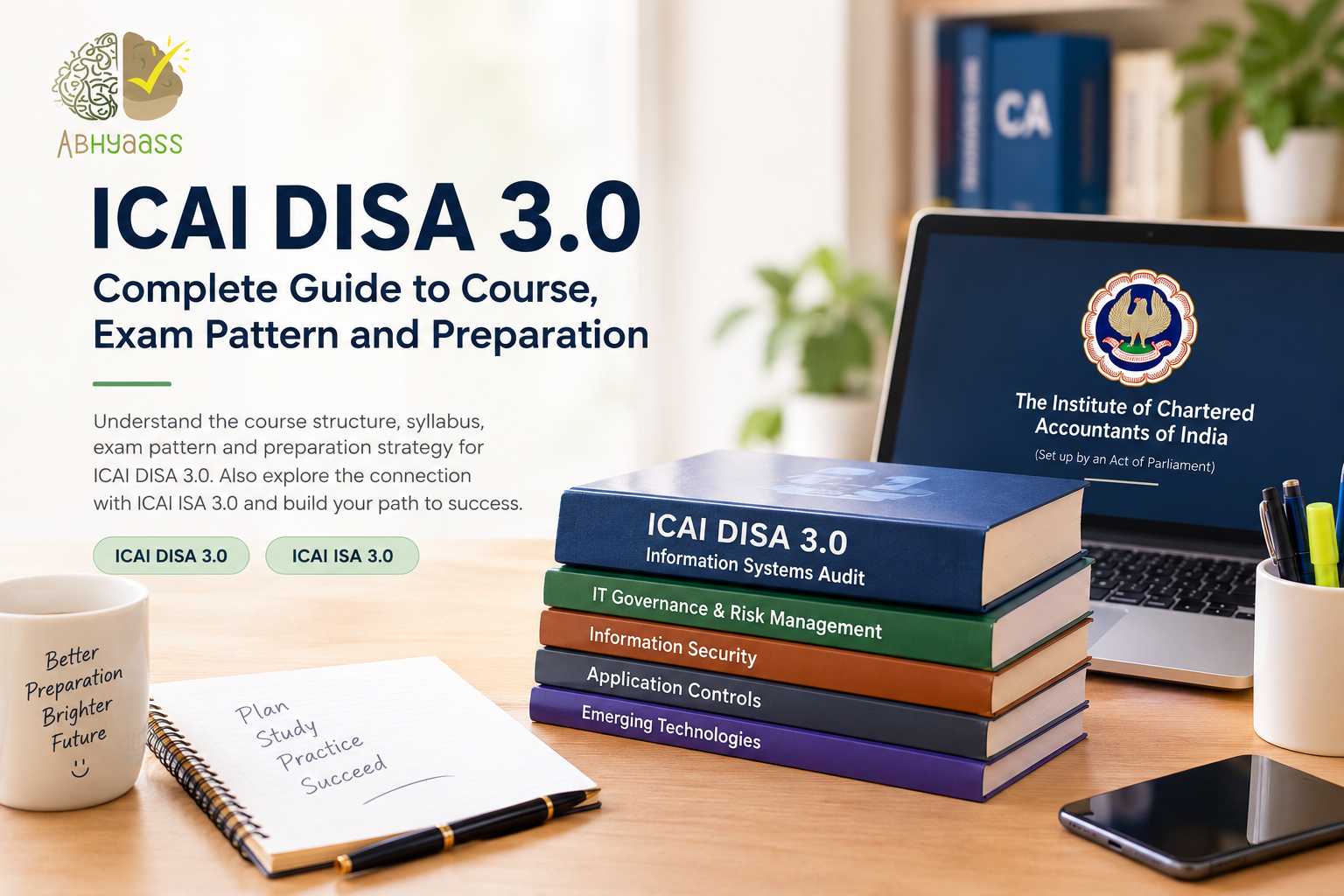
The role of technology in accounting and auditing has changed significantly over the last few years. Businesses now rely on digital systems, cloud platforms, automated processes and electronic records to manage their financial operations. While these developments improve efficiency, they also create new risks related to data security, system controls, compliance and information technology.
For Chartered Accountants, understanding these risks is becoming increasingly important. This is where the ICAI DISA 3.0 course comes into the picture. Offered by the Institute of Chartered Accountants of India (ICAI), the Diploma in Information Systems Audit is designed to develop the knowledge and practical skills required to work in the field of information systems auditing.
If you are planning to pursue DISA or want to understand the course structure, examination process and preparation strategy, this guide will help you get started. At Abhyaass, our aim is to help CA professionals access useful learning resources and approach their professional examinations with greater confidence.
What Is ICAI DISA 3.0?
ICAI DISA 3.0 refers to the updated version of the Diploma in Information Systems Audit course conducted by ICAI. It focuses on information systems auditing, technology-related risks, IT governance, information security and the evaluation of controls within computerised business environments.
The course is intended to help Chartered Accountants understand how technology affects business processes and financial reporting. Rather than focusing only on traditional auditing procedures, it introduces the concepts and techniques needed to assess the reliability, security and effectiveness of information systems.
For example, an organisation may use accounting software to record transactions, manage inventory and generate financial statements. An information systems auditor needs to understand whether access to the software is properly controlled, whether changes to financial data can be tracked and whether appropriate backup and recovery procedures are in place.
These are the kinds of practical considerations that make information systems auditing an important area of professional development.
What Is the Difference Between ICAI ISA 3.0 and DISA 3.0?
The terms ICAI ISA 3.0 and ICAI DISA 3.0 are closely connected and are often used interchangeably when people search for information about the course.
ISA stands for Information Systems Audit, while DISA refers to the Diploma in Information Systems Audit. The ISA 3.0 course is the training and assessment framework associated with the DISA qualification.
In simple terms, ISA 3.0 relates to the course and its learning process, whereas DISA refers to the diploma awarded after successfully meeting the applicable course and examination requirements.
Understanding this distinction is useful when searching for official course information, registration instructions, study materials or examination updates. Candidates should always refer to the current ICAI guidelines for the precise requirements applicable to their batch.
Why Should Chartered Accountants Consider DISA 3.0?
Technology has become an integral part of almost every business function. Even organisations that operate on a relatively small scale may use cloud-based accounting software, online payment systems, digital invoicing platforms and electronic document management systems.
This creates opportunities for Chartered Accountants who can evaluate both financial controls and the technology supporting them.
The ICAI DISA 3.0 course can help professionals build a foundation in information systems audit, IT risk management and information security. These skills may be useful when working on technology-related assurance assignments, internal audits, IT control reviews and risk assessment engagements, depending on the professional's experience and the scope of the assignment.
Another advantage is that the course encourages candidates to look beyond financial figures and consider the systems that generate, process and protect business information.
However, completing the course should not be viewed as an automatic guarantee of employment, clients or professional assignments. The practical value of the qualification depends on how effectively a professional applies the knowledge gained and keeps up with changes in technology.
ICAI DISA 3.0 Course Structure and Syllabus
The ICAI ISA 3.0 learning framework covers several areas of information systems auditing. Candidates should review the latest official course structure because course arrangements and assessment requirements can be updated by ICAI.
Information Systems Audit Process
This area introduces the systematic approach to planning and performing an information systems audit. Candidates learn why audit objectives, risk assessment, evidence collection, control evaluation and reporting are important when reviewing technology-driven processes.
Understanding the audit process helps professionals connect technical observations with business risks and appropriate recommendations.
IT Governance, Risk Management and Compliance
IT governance concerns how an organisation directs and manages its technology resources. Risk management involves identifying potential threats to systems and evaluating their possible impact on business operations.
This part of the course helps candidates understand how policies, responsibilities, controls and compliance procedures contribute to effective technology management.
System Development and Application System Audit
Business applications are frequently used to process transactions, maintain customer information and prepare reports. Auditors need to understand the risks associated with developing, acquiring, implementing and maintaining these systems.
The subject also highlights the importance of change management, application controls, authorisation procedures and the reliability of system-generated information.
Information Systems Operations and Management
Information systems must operate reliably to support business activities. This area addresses operational controls, system monitoring, incident management and continuity-related considerations.
For auditors, the objective is to assess whether the organisation has appropriate processes to manage its systems and respond to disruptions.
Protection of Information Assets
Data security is a major concern for organisations that store confidential financial, employee and customer information. This part of the syllabus covers the importance of protecting information assets through suitable security controls.
Candidates should develop a clear understanding of access management, data protection, security policies and the risks associated with unauthorised access or disclosure.
Emerging Technologies
Technology continues to evolve, and auditors need to understand how new developments can affect business risks and controls. Emerging technologies may introduce opportunities for automation and efficiency, but they can also create new challenges involving security, governance and accountability.
Candidates should focus on understanding the audit implications of technology rather than memorising isolated definitions without context.
ICAI DISA 3.0 Exam Pattern and Assessment Process
One of the most important steps in preparing for ICAI DISA 3.0 is understanding the complete assessment process. The qualification involves more than simply preparing for the final examination.
Under the published ISA 3.0 course structure, candidates are required to complete the prescribed e-learning component and its assessment, attend professional training, complete the required module tests and project work, and meet the applicable attendance and performance criteria before progressing to the subsequent assessments.
The professional training component has been structured around practical learning, including classroom sessions, hands-on activities and case-based work. The published course structure describes 72 hours of professional training across 12 physical sessions, with three module tests and a group project that includes a viva.
The published framework specifies a minimum of 90% attendance for professional training and an aggregate score of at least 60% across the module tests and project work to qualify for the ISA Eligibility Test. Candidates who satisfy the applicable eligibility requirements can then proceed to the subsequent assessment stages.
The ISA Assessment Test is a separate examination conducted under ICAI's examination process. Its examination format, eligibility requirements, application dates, fees and passing criteria should be checked against the relevant official notification.
It is important not to confuse the module tests, Eligibility Test and final Assessment Test. Each serves a different purpose in the overall qualification process.
For the latest applicable requirements, candidates should consult the official ICAI Digital Accounting and Assurance Board course portal and the ISA Assessment Test portal.
How to Prepare for the ICAI DISA 3.0 Examination
Preparing for the ICAI DISA 3.0 assessment requires a combination of conceptual understanding, practical application and consistent revision. Since the course deals with information systems and technology-related risks, relying entirely on memorisation may not be sufficient.
Start With the Official Study Material
Begin with the prescribed course material and e-learning modules available through ICAI. Make sure you understand the learning objectives before moving to additional resources.
Avoid collecting too many notes or reference documents at the beginning. A clear understanding of the official material provides a stronger foundation for revision and practice.
Build Your Understanding of IT Controls
Instead of memorising every topic in isolation, connect the concepts with practical business situations. For example, consider what could happen if several employees share the same login credentials or if changes to an accounting application are made without proper approval.
Thinking through such examples makes it easier to understand why controls are required, what risks they address and how an auditor might evaluate their effectiveness.
Practise Questions Regularly
Question practice helps identify gaps in understanding and improves your ability to apply concepts under examination conditions. Use relevant practice questions, module assessments and mock tests where available.
At Abhyaass, candidates can explore learning resources relevant to their preparation and use them alongside the prescribed ICAI material. Always ensure that any practice questions you use reflect the applicable syllabus and are not presented as official past examination questions unless their origin has been verified.
Revise Every Module Systematically
Leaving all revision until the final few days can make the syllabus difficult to manage. Review each module after studying it and maintain concise notes covering key concepts, risks, controls and important distinctions.
Regular revision also makes it easier to identify topics that need further attention before the examination.
Follow Official Examination Updates
Examination notifications can specify important details such as application windows, eligibility requirements, assessment dates and examination procedures. Check the official ICAI portal regularly and avoid relying entirely on old articles or information shared on social media.
A well-planned preparation schedule should account for both learning and administrative requirements, including completing the prescribed course components before the relevant deadlines.
Career Opportunities After DISA
The ICAI DISA 3.0 qualification can support professional development in areas where accounting knowledge intersects with information technology and risk management.
Depending on their existing experience, technical skills and the requirements of a particular role, qualified professionals may explore opportunities related to information systems audit, IT general controls, internal audit, technology risk assessment, information security controls and technology-focused assurance assignments.
For example, an auditor reviewing an organisation's accounting environment may need to examine user access, transaction authorisation, system-generated reports and backup procedures. Knowledge of information systems auditing can help the auditor ask better questions and evaluate technology-related risks more effectively.
The qualification can be particularly relevant to professionals who want to expand their understanding of technology-driven business environments. However, individual career outcomes will depend on experience, practical competence, client requirements and ongoing professional development.
How Abhyaass Can Support Your Preparation
Preparing for a professional qualification becomes more manageable when study material, practice and revision follow a clear structure.
Abhyaass aims to support CA professionals by providing relevant learning resources and exam-preparation content. Candidates preparing for ICAI DISA 3.0 or ICAI ISA 3.0 can use suitable notes, practice questions and revision resources alongside the official ICAI course material.
The most effective approach is to identify your weaker areas, revise the prescribed content consistently and practise applying concepts to realistic audit situations. Study resources should complement the official syllabus rather than replace the course requirements or the guidance issued by ICAI.
Before choosing any course-specific resource, check that its content is relevant to your syllabus and examination cycle.
Conclusion
The growing dependence on digital systems has made information systems auditing an important area of professional knowledge for Chartered Accountants. The ICAI DISA 3.0 course provides a structured pathway for developing an understanding of IT governance, information security, technology risks and audit controls.
Success requires more than completing the learning modules. Candidates should understand the course structure, meet the prescribed training and assessment requirements, practise regularly and follow official examination notifications.
If you are planning to pursue ICAI ISA 3.0 and the DISA qualification, begin by reviewing the official course material and preparing a realistic study schedule. With consistent effort, practical learning and the right revision strategy, you can build a stronger foundation in information systems auditing.
Abhyaass encourages candidates to approach their preparation systematically, use reliable learning resources and stay informed about relevant course updates.
Frequently Asked Questions About ICAI DISA 3.0
1. What is ICAI DISA 3.0?
ICAI DISA 3.0 stands for the Diploma in Information Systems Audit course offered by the Institute of Chartered Accountants of India (ICAI). It focuses on information systems auditing, IT governance, information security, risk management and technology-related audit controls.
2. What is the difference between ICAI DISA 3.0 and ICAI ISA 3.0?
ICAI DISA 3.0 refers to the diploma qualification, while ICAI ISA 3.0 refers to the Information Systems Audit course and its associated training and assessment framework. Candidates should check ICAI's latest course guidelines for the applicable version and terminology.
3. What is the syllabus of ICAI DISA 3.0?
The ICAI DISA 3.0 syllabus covers information systems audit, IT governance, risk management, application controls, information systems operations, information security and emerging technologies. Candidates should refer to the official ICAI study material for the complete syllabus applicable to their batch.
4. How can I prepare for the ICAI DISA 3.0 examination?
To prepare for the ICAI DISA 3.0 examination, study the prescribed ICAI material, complete the required training, revise each module regularly and practise relevant questions and mock tests. Using structured revision notes from platforms such as Abhyaass alongside official resources can also support your preparation.
5. Where can I find ICAI DISA 3.0 notes and practice questions?
Candidates can access prescribed learning resources through ICAI's official course portal and supplement their preparation with relevant notes and practice questions from educational platforms such as Abhyaass. Always verify that the resources match the current syllabus and examination requirements.
Continue your preparation with Abhyaass
Use relevant learning resources alongside prescribed ICAI material and verify current course requirements through official ICAI updates.